Tailorable Force-Sensing Skins
Textile and additive-manufactured sensing layers for whole-arm contact; accepted at IROS 2026.
The question
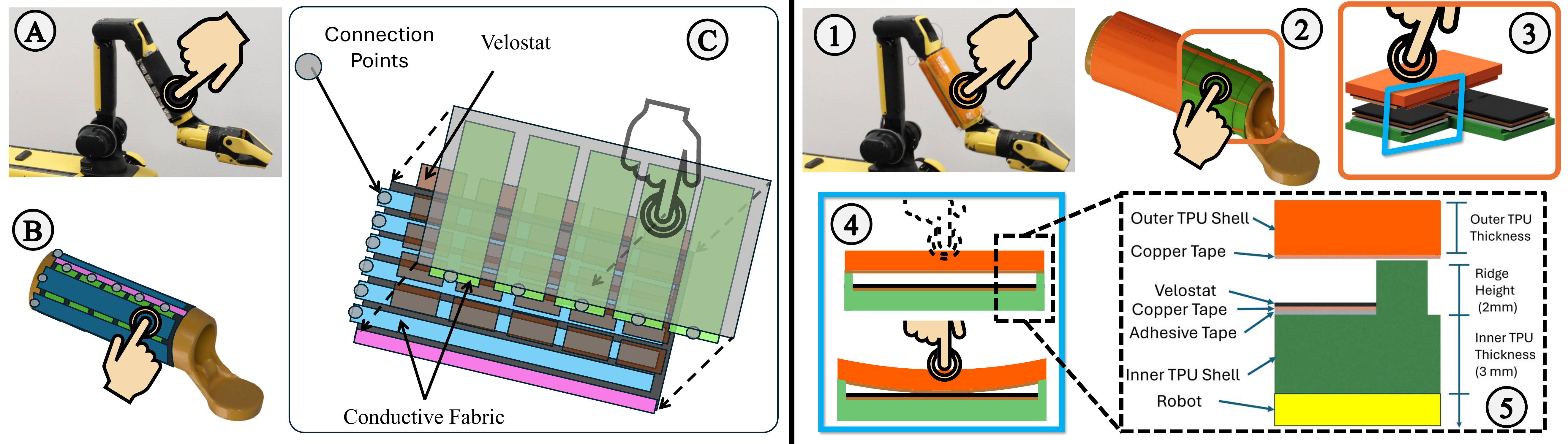
How can a robot sense contact along its arm without relying only on force/torque sensors at the wrist? With Heidi Woelfle, Brad Holschuh, and Karthik Desingh, I developed a tailorable force-sensing skin that combines textile sensing materials with additive-manufactured structures.
The work studies fabrication, sensor response, and integration on manipulator surfaces. It is accepted for the IROS 2026 conference proceedings. A related submission was accepted as a poster at the IROS 2026 Scalable Tactile Sensing for Dexterous Manipulation workshop.
Why it matters
Contact can happen anywhere along a robot’s body. A distributed skin could help detect and localize those interactions, supporting safer and more capable contact-aware manipulation. The project is part of my broader work on learning to use body contact.
Project materials
The published project page reports sensor experiments. Extensions toward full-body coverage and contact-aware control are ongoing research, not claims of completed robot-wide validation.
See the sensors in use
Physical interaction and sensor readouts
These six recordings come from my IROS lightning talk. Each preserves the physical view above and the sensor visualization below, with the original timing. The colored taxels show the recorded sensor response; consult the paper for calibration and quantitative evaluation.
Textile skin: contact avoidance
The robot responds to contact on its textile-covered arm. The lower panel shows the recorded taxel visualization from the same presentation video.
Printed skin: opening a door
Spot uses its printed arm skin during a door-opening task while holding a tray. Physical footage and the recorded sensor visualization appear together.
Textile skin: human interaction
Hand contact with the textile skin is shown above the corresponding color-coded taxel view.
Printed skin during grasping
Spot grasps an object with the printed skin installed on its arm. The recorded taxel view remains visible throughout the clip.
Textile skin: door contact
The textile-covered arm interacts with a door, shown together with its recorded taxel visualization.
Printed skin: table contact
The printed skin contacts a table. The lower panel makes the recorded taxel response visible alongside the physical interaction.